Imagine It, Model It... Hold It In Your Hand
3D printing. Imagine it, model it and then… hold it in your hand. Turn it. Flip it upside down, if you want. Every angle is yours to inspect.
The technology has been all the rage in hobbyists’ and makers’ spaces for over a decade, and its rapid improvement led our Construction Technology (CT) teams to do what they do best: consider the implications, redefine possibility and turn a powerful new technology into real advantages for our clients and partners.
3D printing, as an augment to our teams’ digital 3D modeling, helps clients visualize a project over time, better understand the physical space between design elements and jobsite infrastructure and even consider the implications of nearby traffic flow.
Strength in Simulation
It’s one thing to say that 3,000 linear feet of rebar or 1,000 cubic yards of aggregate need to be stored between the project, the jobsite trailer, an active road and the equipment yard, but what if you could see, spatially, what that actually looks like? What if you could hold it in your hand, inspect it from every angle, imagine yourself walking between each element?
With 3D printing, you can.
This technology is not new. Fused Deposition Modeling (FDM) printers like those our teams use were first introduced in the 1980s. Improvements in manufacturing and printable materials like polylactic acid (PLA) then led to a rapid explosion in the 2010s.
.jpg?sfvrsn=bda386b6_1) On one higher education pursuit, our team recognized the advantages for the client early on, printed a model, ultimately won the project and continued to use the model as a powerful tool for value generation driven by collaboration.
On one higher education pursuit, our team recognized the advantages for the client early on, printed a model, ultimately won the project and continued to use the model as a powerful tool for value generation driven by collaboration.
“A 3D-printed model begins with the same kind of digital modeling we already do for nearly every project. However, we can go one step further and create a mall-scale project that allows us to collaborate with internal team members for more efficient site planning, thus providing our clients with a better work product,” says Dusan Selezan, business development director in California. “It also offers continuing value for every stakeholder. We can bring the model back out during the construction phase to physically show where trades are working, where materials will be stored and what vehicle and pedestrian routes will remain open.”
When you can more precisely imagine something, you can make better and more confident project decisions. But client stakeholders may not always be familiar with construction processes or not as readily able to visualize the nuances of a busy and complex project site.
Over subsequent projects across the entire US Buildings business, our teams have improved and refined the level of detail in our models. Parking spaces, material laydown areas, project trailers, construction vehicles and so much more can be printed to scale and moved around the model to simulate project progress.
Our teams now create project models with magnetic baseboards and individually magnetized elements – fully modular and tactile tools that persist in their collaborative power from week to week.
Safety in Miniature
On one school bus depot and district offices improvement project, our team further proved that printing a project in miniature can present powerful advantages for safety processes, especially in close proximity to live traffic, which Balfour Beatty has formally identified as the fifth major Fatal Risk.
The bus depot portion of the project involved a below-grade service ramp that required significant excavation. That said, the district needed the bus yard to remain fully operational throughout construction. .jpg?sfvrsn=e3eed89b_1)
Using their model, complete with appropriately scaled school buses, our team physically demonstrated a reality that might have been hard to imagine, even with a digital model: the existing bus route, from road to yard, was too narrow and too close to the needed excavation, necessitating temporary road access and thus live traffic safety considerations.
“A 3D printed model is limited only by our imagination, and by including every element of a project and even the most impacted adjacent roads, we create a powerful new tool for accomplishing our Zero Harm mission,” adds Claire Mao, senior VDC manager in California. “And jobsites change over time, so the model continues to generate value as our safety plans need revisiting or further collaboration with road and traffic authorities is required.”
The same principle is applicable to virtually any other moving vehicle or heavy equipment on a project site that could pose a hazard to our people, our visitors or the surrounding community. From cranes to excavators to skid steers to the humble 1-ton pickup, we can both digitally and physically model a project with accuracy, prepared for a project lifespan of collaboration to meet changing safety needs.
Rapid Response Prototyping
Constructability problems can emerge rapidly in the construction industry, but 3D printing provides on-demand responses, equally effective as they are prompt.
On one Mid-Atlantic project, our team was faced with restoring and re-installing salvaged trim pieces on a historic building. The process required custom-designed mounting brackets, which also required verification that the brackets would accommodate the actual trim once removed.
By 3D printing prototype brackets ahead of time, our CT team provided a fast track for the project owners to review the solution, confirm alignment with the project’s aesthetic goals and ultimately approve the end product. With 3D printing, our team gave back what so few contractors can: time.
“It can be had to visualize two-dimensional details on paper and understand how that translates to an existing piece of three-dimensional architecture, especially intricate historical designs with extremely low tolerances,” says Bach. “With 3D printing, we were able to move forward with prefabricating our brackets with confidence.”
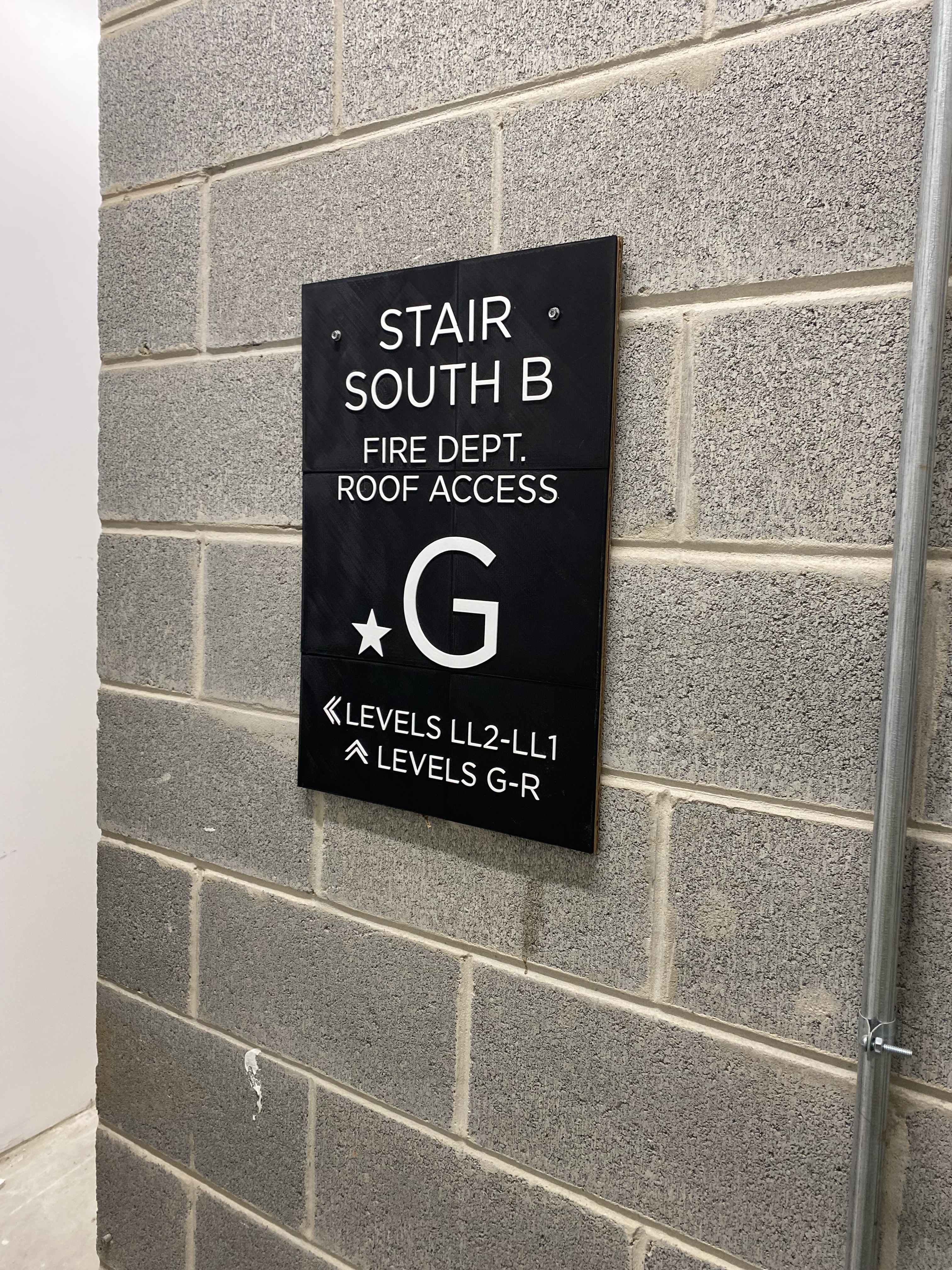
On another Mid-Atlantic project, timely building turnover involved a final life safety inspection with an unexpected need for updated signage. Rather than delay inspections and turnover while waiting for the appropriate signs, our CT team, delivered 3D-printed signage – including braille – within one day, and when the final signs were delivered, the temporary signage was an effortless replacement.
This process is repeatable and endlessly applicable, too. Our CT teams have cultivated a digital library of jobsite signage for any conceivable project inspection need, and can typically turn around a 3D printing job much faster than any outsourced vendor.
With this powerful tool at their disposal, our CT teams across the U.S. can support our teams with project-specific needs and outside-the-box-solutions.
National Knowledge Sharing
Now well out of the “proving grounds” stage, our teams are poised to develop 3D printing in a big way with a national knowledge-sharing working group. Together, and transcending our divisions and business units, the group will collectively improve our library of 3D printing assets and best practices to deliver the best possible client experiences.
“We can accomplish so much with digital modeling, but there is real value and opportunity for collaboration when using a physical 3D print,” Bach adds. “Our clients and partners have repeatedly agreed – looking at and holding a physical model of the site and building is as much a gateway to understanding and collaboration as viewing one on a screen.”