Building Bridges… by Balloon
When the unexpected occurs on a jobsite, the best builders know that the only way forward is through.
For our Howard S. Wright, a Balfour Beatty company (HSW) team in Washington, building three glass skybridges for a world-class, high-tech client was an unprecedented exercise in collaboration. Early constructability testing revealed a seemingly insurmountable challenge: installing 186 irreplaceable glass panels across seven sections, with individual assemblies weighing up to 33,000 pounds. Fortunately, our teams don’t accept roadblocks.
Leveraging the strength of our joint venture with Skanska USA Building Inc., the combined expertise of each firm’s most experienced builders and the invaluable input of carefully selected engineering and trade partners, our team developed a truly innovative, industry-first solution: pre-weighting the skybridges with massive, 20-ton water balloons. More than just an industry-advancing new technique, our partnership’s client advocacy and relentless collaboration proved a masterclass in risk identification and mitigation.
High in the Sky
 As soon as he saw the buildings’ curtain wall and façade designs, HSW Senior Project Manager Spencer Helfrich knew the skybridges would be a feat of construction. Beyond just sheer numbers of panels or pounds, the bridges were all designed by a high-concept, world-class German façade designer to be mullionless (that is, lacking non-glass vertical supports) and fully encased in low-iron and heat-strengthened glass. Each structural integrated glass unit (IGU) was up to five panes thick.
With designs in-hand, the HSW and Skanska team began design coordination and constructability planning. All 186 IGUs were procured early from a German manufacturer.
The project team quickly identified a central problem: the structural glass was heavy. Before even factoring in the mechanical, electrical and plumbing systems (MEP) beneath each bridge, installing the IGUs alone would cause significant deflection in the structural steel, up to one inch at the center of each span.
 “As Relentless Allies for our clients, our mindset is always to collaborate with our partners and mitigate every possible risk,” Spencer says. “Together with Skanska and our entire team, we prevented a lengthy re-design or serious operational failure before it could become a reality.”
Had the team proceeded with the original constructability parameters, each IGU placed would have deflected the steel beams millimeter by millimeter. As the irreplaceable panels would inevitably rack together and grind edge-to-edge, cracking and shattering was equally inevitable.
A Meeting of Minds
 The HSW and Skanska teams developed a comprehensive plan of attack. They retained a third-party consulting engineer; they leveraged our best-in-class BIM and technology experts; they modeled the situation in 3D and ran every calculation possible.
The problem was deceptively simple: the team needed to simulate the structural steel deflection before glass was installed. Solving it was much more complicated. You can’t just string up 33,000 pounds to the underside of a steel beam. Or can you?
“Together – and only together, in collaboration with some of our top experts and industry allies – we developed a plan to utilize crane testing water bags,” Spencer says. “As far as we knew, this had never been done before. We were breaking new ground, and we needed the calculations, models and methods to back it up.”
 Already a critical step in the original constructability assessments, 3D modeling the newly conceived solution now became just as critical. Our Seattle-based BIM Manager Ryan Soules meticulously created a digital twin, allowing the joint venture team to confidently assess the spatial viability of hanging bags from each steel strut and navigating the necessary equipment – cranes, aerial work platforms and more – between this complex jungle of beams, bags and glass.
“It was absolutely essential that we prove the solution’s viability before ever attaching a water bag to the first bridge,” Ryan says. “By modeling the complex task in four dimensions including progress over time, we created a clear, defined and risk-mitigating path forward.”
As the team began loading up and hanging water bags, the sight was something to behold – like 14 total upside-down hot air balloons hanging from the bridges.
The water bags proved ingenious. Fully loaded and properly placed per the team’s calculations and BIM coordination, the bags deflected the structural steel exactly as much as the final state of glass panels and MEP systems. As the team installed each panel, they simultaneously released the same weight in water from the nearest bag. Carefully, meticulously, they maintained equilibrium between water, glass and steel in chunks of several hundreds of pounds. 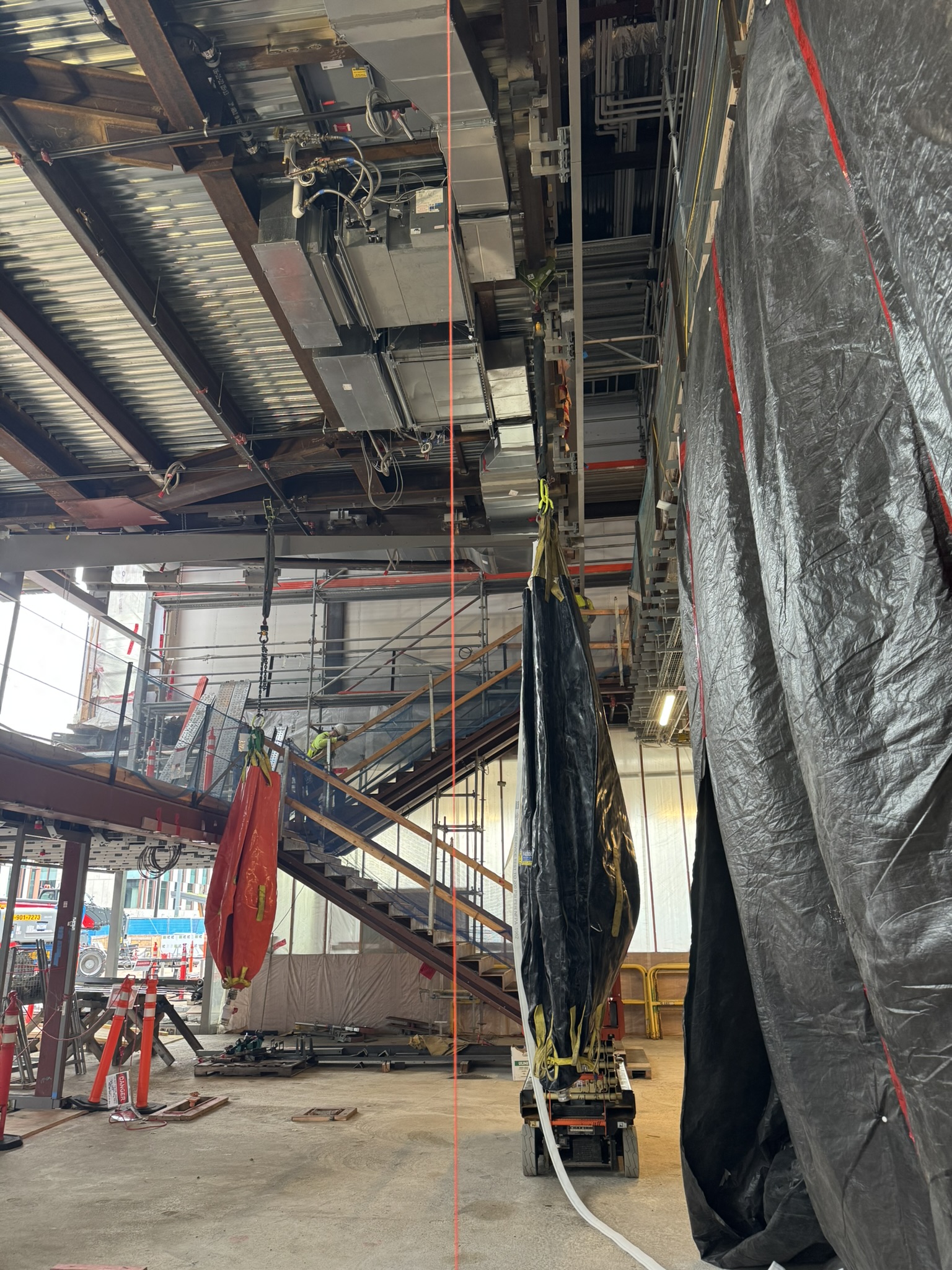
“Our process was the definition of painstaking and high-touch, but it was critical to do this correctly. In a very real way, re-work was simply not an option,” Spencer adds. “We arrived at our solution as one team with one mission, and we erected all three skybridges in the same spirit and with no major setbacks.”
One Team, One Mission
Executing the plan required an ongoing collaborative mindset and intense coordination between every trade. The bridges are vertically arranged and only slightly offset, so not all could be “bagged” simultaneously. Furthermore, continuing MEP work underneath each bridge could easily become entangled by surrounding bags, glass installers or glass finish work like joint caulking.
At every point in the process, the entire team united around one goal: mitigate the schedule and budget risks of this innovative solution and execute the plan flawlessly. Having already overcome a monumental setback, the team met the challenge head-on and ultimately succeeded.
“I’m incredibly proud of what we’ve accomplished here, rallying around our mission and uniting as one team to serve our client with excellence,” Spencer adds.
Together with our partners, Howard S. Wright pushed the industry forward, deployed an experimental and innovative solution, collaborated at every step and delivered a world-class office facility with maximum efficiency and minimal risk. We believe that every client deserves the same commitment to excellence.